







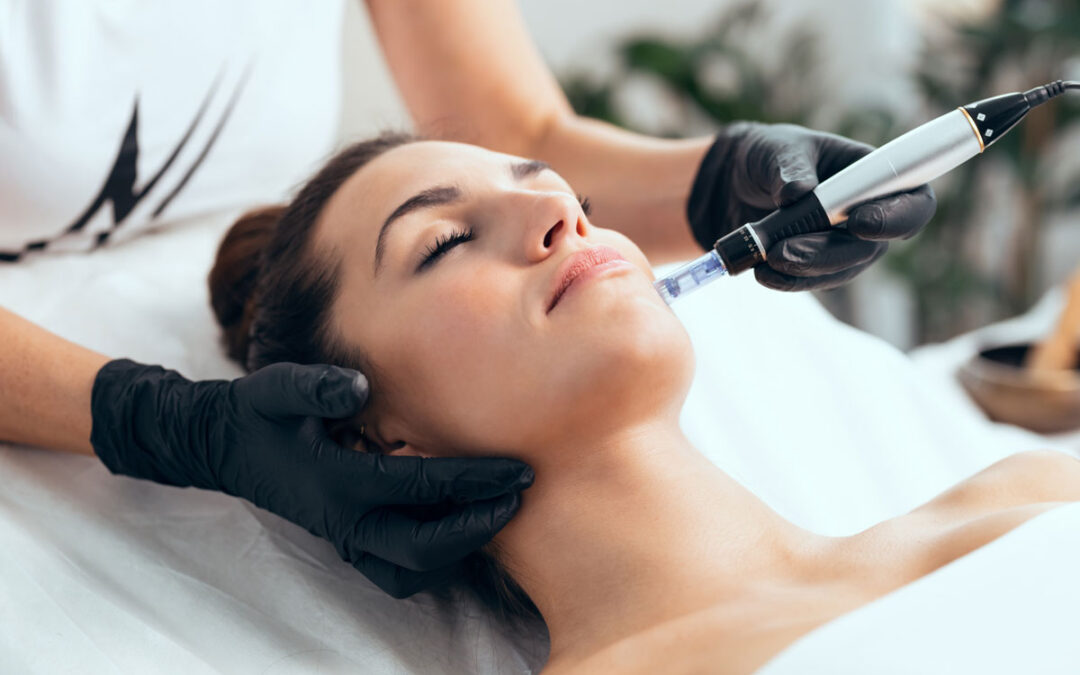
If you are considering microneedling, your practical questions probably come before your cosmetic ones. How many visits will it take? How red will my skin look the next morning? Is it a good fit for my acne scars or my skin tone? This guide answers those questions plainly, so you can decide whether a skin assessment is your next step. Microneedling is one of several medical spa treatments we offer in Napa and Vacaville.
How Microneedling Works
Microneedling is a medical treatment that uses tiny needles to puncture the skin, and it works by stimulating the body to make collagen (American Academy of Dermatology). In clinical terms, the needles create a controlled micro-injury: a uniform, shallow wound in the dermis (the layer of skin beneath the surface) that prompts the skin’s repair response. That response involves growth factors, collagen, and elastin, and remodeling continues for roughly three to six months after treatment (StatPearls). This is why results are judged over months, not days.
What Microneedling Can and Cannot Do
Our microneedling page lists improved skin texture and tone, softer fine lines, and a reduction in the look of acne and surgical scars as treatment goals. Those goals are realistic. Complete scar removal is not.
Two limitations are worth knowing. First, the research is still developing: a StatPearls clinical review notes that evidence-based recommendations for microneedling are lacking, and most guidance rests on smaller studies (StatPearls). Second, timing matters for acne. Active, inflamed acne is listed as a reason to postpone treatment, and the American Academy of Dermatology notes that acne scar treatment generally begins once breakouts are under control (American Academy of Dermatology). Individual results may vary.
Treatment Series: How Many Sessions to Plan For
For most goals, one session is a starting point. Our practice typically recommends a series of three to six sessions spaced about one month apart (Napa Solano Plastic Surgery). Clinical references describe treatment as repeatable after a minimum of three weeks (StatPearls).
Once you complete a series, maintenance is common. One published review describes maintenance treatments every six to 12 months, depending on skin condition and goals (Cureus, 2024).
Redness, Peeling, and Downtime
Most patients experience minimal downtime. Your skin may look red or slightly swollen for 24 to 72 hours, similar to a mild sunburn, and light flaking or dryness can follow as the skin heals (Napa Solano Plastic Surgery). The American Academy of Dermatology reports that these reactions usually fade within a few days to a week, and advises waiting 24 hours before applying makeup (American Academy of Dermatology). Plan a quiet evening after your first appointment rather than a major event.
Before You Book: Skincare Pauses and Sun Protection
Preparation improves your response. The American Academy of Dermatology suggests a skin care routine for two to four weeks before treatment, which may include pausing retinoids for a few days. It also advises delaying treatment after a recent tan or sunburn, and, if you have taken isotretinoin, waiting at least one month after your last dose (American Academy of Dermatology). Tell us about every active product and medication you use, because we will give you specific instructions for your skin.
Afterward, sun protection is the most important habit. Clinical guidance calls for sunscreen with regular reapplication and avoiding sun exposure and harsh chemicals for at least one week (StatPearls). Our aesthetician services can help you build a gentle home routine for before and after your series.
Infection Risk and Cold Sores
Any treatment that breaks the skin carries some infection risk. Localized superficial infections are listed among less common adverse effects, and herpes simplex reactivation (a cold sore outbreak) is also possible. An active cold sore or other infection in the treatment area is a reason to reschedule (StatPearls). If you are prone to cold sores, tell us at your assessment so we can discuss whether additional precautions make sense for you.
Sterile technique and proper aftercare lower risk, which is one reason to avoid home devices. The American Academy of Dermatology warns that at-home microneedling can spread warts, herpes, and other viruses across the skin (American Academy of Dermatology).
Skin Tone Considerations
The American Academy of Dermatology states that microneedling is safe for all skin tones (American Academy of Dermatology). It also notes that darker skin may show darker shades on the treated area for a few days to a week after treatment. A published review adds that people with darker skin types may be more susceptible to post-inflammatory hyperpigmentation (dark marks after skin irritation), which usually resolves within a few weeks, and recommends sun protection (Cureus, 2024). Tell us if you tend to develop dark marks after pimples or minor injuries.
When Deeper Scars Need Another Option
Not every acne scar responds the same way. The American Academy of Dermatology notes that ice pick scars require different treatment than rolling scars, that fillers can add volume to depressed scars, and that minor surgery can lift sunken ones. It also states that your care may combine more than one treatment (American Academy of Dermatology). In one small split-face study, a fractional laser produced greater scar improvement than microneedling, although microneedling had shorter downtime (Journal of Drugs in Dermatology, 2017). If your scars are deep, we may discuss skin resurfacing options alongside, or instead of, microneedling.
Microneedling vs. Radiofrequency Microneedling
We hear this question often, so here is the main difference. Conventional microneedling relies on the needle injury alone. Radiofrequency (RF) microneedling combines microneedling with radiofrequency energy, using needles that deliver heat deep into the skin (Cureus, 2024).
The same review lists deeper skin tightening and effectiveness for scars as advantages of RF microneedling, and cost and procedural complexity as disadvantages (Cureus, 2024). The American Academy of Dermatology states that RF microneedling is safe for all skin tones, though studies comparing it with laser included a small number of people with darker skin (American Academy of Dermatology). It also reports that combining radiofrequency and microneedling can produce less noticeable acne scars than either approach alone.
In practice, the better choice depends on your goals, skin type, and scar depth. Availability also varies by practice, so ask any provider which technology they use and why it suits your skin. An in-person assessment is the most reliable way to match the technology to the goal.
Microneedling FAQs
Does microneedling hurt?
Pain during treatment is described as minimal when a topical anesthetic is used (StatPearls).
When will I see results?
Visible improvement may appear after one treatment, and a series builds on it (Napa Solano Plastic Surgery). Collagen remodeling continues for three to six months (StatPearls).
Is a home derma roller the same thing?
No. Manual rollers have limited needle depth, which often makes them less effective than professional devices (Cureus, 2024).
Read More and Request a Skin Assessment
Read our microneedling page for treatment details, then request a skin assessment. We will review your skin, your goals, and your medical history, and explain which options fit. Consultation is required to determine candidacy, and not all candidates are suitable for every procedure. Individual results may vary.
References
- American Academy of Dermatology. Microneedling can fade scars, uneven skin tone, and more. Last updated July 17, 2023.
- American Academy of Dermatology. Acne scars: Consultation and treatment. Last updated December 8, 2023.
- Litchman G, Nair PA, Badri T, Kelly SE. Microneedling. StatPearls Publishing. Last updated September 26, 2022.
- Jaiswal S, Jawade S. Microneedling in Dermatology: A Comprehensive Review of Applications, Techniques, and Outcomes. Cureus. 2024;16(9):e70033.
- Bonati LM, Epstein GK, Strugar TL. Microneedling in All Skin Types: A Review. Journal of Drugs in Dermatology. 2017;16(4):308-314.